Tadashi Yamamoto, director of the Cooperative Laboratory for Electron Microscopy in the Faculty of Medicine, Niigata University.
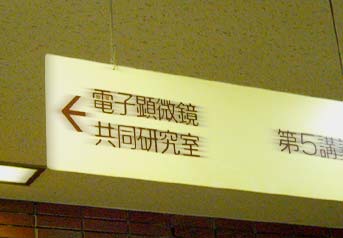
The Cooperative Laboratory for Electron Microscopy houses four transmission electron microscopes and two scanning electron microscopes in the first floor of the Cooperative Laboratory Building. Projects are turned around in a few days to weeks or more, depending on the requirements of the job and the number of samples provided.
Electron microscopy can magnify a sample theoretically to the angstrom level, a level at which individual molecules can be detected. To prepare a sample for electron microscopy, tissues or cells are fixed and embedded in resin for support, then cut into extremely thin slices (70 nanometers thick) using a diamond knife. The sections are then picked up on a mesh grid and stained with heavy metals such as uranium or lead for contrast. In the electron microscope, the various lenses are electromagnets that essentially manipulate the beam of electrons in a manner comparable to the glass lenses of the light microscope. In the transmission electron microscopes, the beam of electrons passes through the sample and the electrons impact the phosphorescent screen to create the image of the sample.
Masaaki Nameta is an expert technician for the sectioning of the samples and viewing under the adjusts the focus, contrast, brightness, and magnification of the black-and-white images Although electron microscopy offers extremely high magnification and better resolution than the light microscope, preparing samples for this technique can be a time-consuming process. "In immuno-electron microscopy, it's often a balancing act to find a suitable fixative that will preserve cells without destroying antigenicity.
For more information on the Cooperative Laboratory for, Electron Microscopy contact Tadashi Yamamoto, x2151 or e-mail tdsymmt@med.niigata-u.ac.jp or Masaaki Nameta, x2173 or e-mail nametan@med.niigata-u.ac.jp . Download an application form
Masaaki Nameta does all the procedure and even observation and taking photographs. Fees listed in a separate chart are charged to applicants or their departments
Electron Microscope Core Facility, Niigata University
1-757 Asahimachi-dori Niigata 951-8510, Japan
A general manager : Tadashi Yamamoto
E-mail tdsymmt@med.niigata-u.ac.jp
TEL 2152(Department of Structural Pathology Institute of Nephlorogy, Professor room)
A technical officer : Masaaki Nameta
E-mail nametan@med.niigata-u.ac.jp
TEL 2173(Electron Microscope Core Facility, Technical officer room)